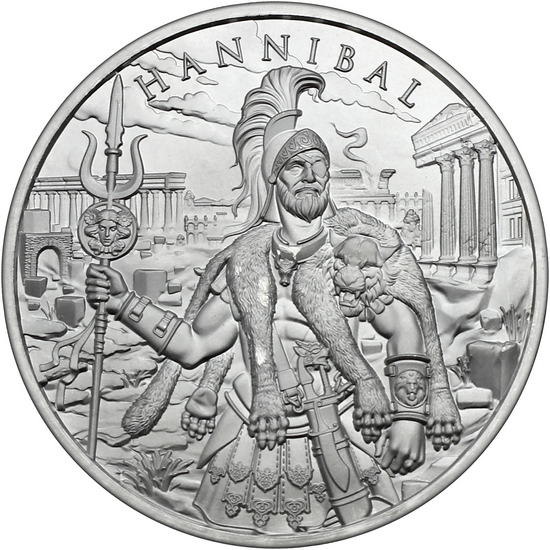
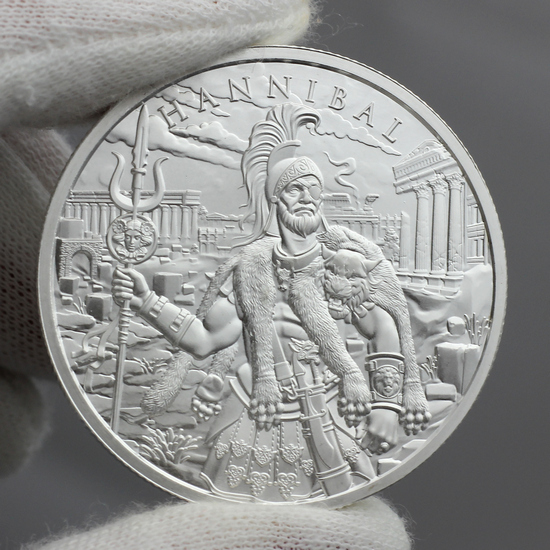
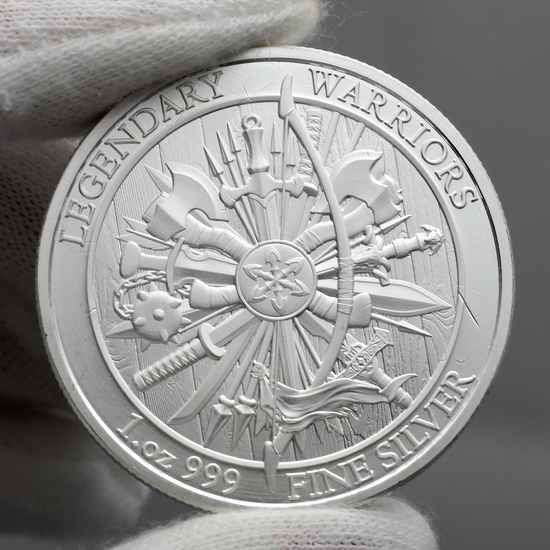
Our series honoring Legendary Warriors continues with the ninth release. Featured on silver medallions, our next warrior remains one of antiquity’s most formidable commanders. A strategist who's daring nearly halted Rome’s rise, his career blends bold tactics with complex politics as his enduring legacy continues to shape military thought and popular culture.
Hannibal
Hannibal’s full name was Hannibal Barca. In Punic, Hannibal likely meant “Grace of Baal” or “Favored by Baal,” reflecting Carthage’s religious traditions. Carthaginian names often paired a theophoric given name with a family identifier. The cognomen Barca, meaning “Thunderbolt,” marked his influential clan, either inherited or earned by his father’s ferocity in war. The identity of Hannibal Carthaginian leader is inseparable from this lineage, which produced multiple commanders and statesmen.
Family Background
The Barca family dominated Carthaginian affairs in the late third century BCE. His father, Hamilcar Barca, emerged from the First Punic War as a leading general and rebuilt Carthaginian power in Spain. Hannibal’s brothers, Hasdrubal and Mago, and his brother-in-law, Hasdrubal the Fair, also held senior commands. This family network drove Carthage’s expansion in Iberia and later underpinned Hannibal’s army. Through Hamilcar Barca’s campaigns, Hannibal Barca absorbed a culture of command that would define his career.
Hamilcar’s prestige and the family’s status opened doors for Hannibal from an early age. He accompanied his father on campaign, gaining a practical education in command, logistics, diplomacy, and alliance-building. The Barca influence ensured that when leadership changed in Spain, Hannibal rose quickly with the backing of loyal veterans and Iberian allies who trusted the family’s patronage. Carthaginian general Hannibal thus emerged not only as a battlefield genius but also as the product of a powerful political dynasty.
Early Life and Rise to Command
Born in 247 BCE, likely in Carthage, Hannibal Barca grew up amid maritime trade, political rivalry, and military rebuilding after the First Punic War. His training emphasized languages, cavalry skills, siege craft, tactics, and negotiation—tools essential for leading diverse troops and ruling far-flung territories. From the outset, the trajectory of Carthaginian general Hannibal intertwined with Carthage’s recovery.
His formative years unfolded in Spain. Under Hamilcar Barca and later Hasdrubal the Fair, he learned to integrate Iberian and African forces, secure tribal alliances, and use mobility to offset stronger opponents. These campaigns sharpened his instinct for surprise, envelopment, and decisive cavalry action. In every respect, Hannibal Carthaginian leadership was forged on the Iberian frontier.
Ancient sources report that as a boy he swore an oath of hostility toward Rome at his father’s urging. Whether literal or symbolic, it captured the Barca vision that Rome was the primary rival. After Hasdrubal the Fair’s assassination in 221 BCE, the army in Spain chose Hannibal as commander, and Carthage ratified the decision. Early victories consolidated Carthaginian control south of the Ebro River and set the stage for war with Rome, propelling Hannibal Barca to supreme command.
The Second Punic War
The trigger came at Saguntum, a Roman-aligned city south of the Ebro. Hannibal’s siege and capture of Saguntum in 219 BCE provoked Rome and ignited the Second Punic War. Anticipating Roman offensives in Spain and Africa, he chose a bold counterstrategy: carry the fight into Italy. He led a multinational army over the Pyrenees and the Rhône, then undertook the legendary Alpine crossing in late 218 BCE—a grueling feat that cost many lives but astonished the Mediterranean world.
Once in northern Italy, he moved quickly. At the Trebia River (218 BCE), he drew Roman forces across icy waters into an ambush, using hidden troops to crush their flank. At Lake Trasimene (217 BCE), he sprung a massive surprise attack through fog and rugged terrain, destroying a Roman army and killing the consul Flaminius. His masterpiece came at Cannae (216 BCE), where a convex infantry center absorbed the Roman advance while African infantry and superb Numidian and Iberian cavalry enveloped the flanks—still the classic example of a double envelopment and decisive battle design.
Hannibal excelled at integrating diverse contingents—Libyan heavy infantry, Iberian swordsmen, Gallic warriors, and Numidian light cavalry—and tailoring tactics to terrain and enemy habits. His combined arms coordination, rapid reconnaissance, and cavalry superiority let him shape engagements before the infantry clash. Carthaginian general Hannibal mastered the art of drawing opponents into disadvantageous terrain and tempo.
Logistics defined his limits as much as tactics defined his triumphs. Operating far from Carthage, he relied on foraging, local alliances, and irregular seaborne support. Weather, attrition, and the need to garrison allies stretched his forces. Without steady reinforcements—especially siege equipment and heavy infantry—Hannibal Barca could win battles but struggled to compel Rome’s surrender or seize fortified cities.
Political and Psychological Warfare
Hannibal matched battlefield brilliance with diplomatic reach. He courted disaffected Italian communities, secured allegiance across parts of southern Italy after Cannae, and coordinated with Philip V of Macedon to divert Roman attention eastward. In Spain, his family’s campaigns tied down Roman forces, while in the Po Valley he worked to rally Gauls frustrated by Roman expansion. This multi-front pressure defined Hannibal Carthaginian statecraft as much as his battlefield victories.
Psychologically, he relied on deception and surprise. He exploited terrain, feints, and night movement to unsettle opponents. Each major victory eroded Roman morale and prestige, spurring defections and forcing Rome to adapt. Accounts of his restraint toward civilians and his ransoming of prisoners—though not always consistent—helped craft a reputation aimed at winning allies as well as battles. Such measures reinforced the image of Carthaginian general Hannibal as both strategist and diplomat.
Rome’s counter was strategic patience. The dictator Fabius Maximus adopted a war of attrition—shadowing Hannibal, cutting his foraging, and avoiding pitched battle. Over time, Rome rebuilt its armies, improved cavalry training, and rotated commanders to blunt Hannibal’s edge. As Rome secured Spain and tightened naval control, the strategic balance shifted. Hannibal could not trigger a nationwide Italian revolt, and cautious Carthaginian politics limited the payoff of his early triumphs.
Later Career, Defeat, and Exile
While Hannibal held out in southern Italy, the war’s center of gravity shifted. Publius Cornelius Scipio (later Africanus) dismantled Carthaginian power in Spain through flexible tactics and savvy diplomacy with Iberian communities. Rome then carried the fight to North Africa, pressuring Carthage and forcing Hannibal’s recall. The arc of Hannibal Barca's campaigns now turned toward a decisive test on African soil.
The decisive battle came at Zama in 202 BCE. Scipio neutralized Carthaginian elephants by opening lanes and using disciplined maniples, then leveraged superior cavalry—especially Numidians under Masinissa—to route Hannibal’s flanks and strike the rear of his infantry. Hannibal’s veterans fought hard, but Roman coordination and allied support prevailed. Even in defeat, Carthaginian general Hannibal demonstrated resilience and tactical flexibility.
After the war, Hannibal served as suffete, a senior magistrate in Carthage. He introduced financial reforms to pay Rome’s indemnity and attacked corruption by revising the Council of Elders and administrative procedures. These policies won popular support but antagonized entrenched elites and alarmed Rome, which feared his influence.
Facing renewed Roman pressure, Hannibal went into exile. He advised eastern rulers, including the Seleucid king Antiochus III, and later found refuge with smaller Anatolian princes. Pursued by Roman diplomacy, he ultimately took his own life—traditionally by poison—rather than be surrendered. Ancient sources differ on the exact place and date; Libyssa on the Sea of Marmara is often cited, with dates from the 180s to the early 170s BCE. The long shadow of Hannibal Carthaginian exploits extended well beyond his homeland.
Legacy, Historical Debate, and Cultural Impact
Ancient historians such as Polybius and Livy—though writing from a Roman perspective—acknowledged Hannibal’s mastery of strategy, intelligence, and logistics. Modern scholarship highlights his operational audacity, coalition management under pressure, and precise control of battlefield geometry, while noting his constraints: limited siege capabilities, dependence on allies, and insufficient long-term support from Carthage. He remains the commander who repeatedly outmaneuvered larger Roman forces and redefined maneuver warfare.
Hannibal’s influence permeates military thought. The Cannae model inspired generals from Frederick the Great to Schlieffen, and modern doctrine still studies his use of reconnaissance, deception, and concentric attacks. Key lessons include the value of integrated arms, the primacy of intelligence and speed, and the imperative to align tactical victories with sustainable logistics and political objectives. In biographies of Hamilcar Barca and studies of Hannibal Barca, these themes recur as hallmarks of Punic-era warfare.
Beyond the battlefield, Hannibal endures in literature, art, and media. Renaissance histories, epic paintings of the Alpine crossing, and countless novels and documentaries keep his story alive. Museums and private collections display artifacts linked to Punic and Roman contexts: Carthaginian bronzes, coins from allied Iberian mints, and Roman issues commemorating victories over Carthage.
Debate continues over counterfactuals—what if Carthage had fully reinforced Hannibal after Cannae, or if he had besieged Rome? Most historians argue that Rome’s manpower reserves, political resilience, and Fabian adaptations would still have posed immense hurdles. Yet Hannibal’s campaigns remain a benchmark for how intelligence, speed, and coalition warfare can reshape a conflict—even against a rising superpower. The legacy of Hannibal Carthaginian leadership endures because it integrates bold vision with the hard realities of supply, alliances, and time.
Collect the Legendary Warriors Series
Explore all currently available Hannibal silver medallion releases and browse the complete Legendary Warriors Series featuring iconic historical leaders commemorated in 1 oz .999 fine silver.
Looking to own every release issued to date? Shop the Legendary Warriors Series complete collection set and secure one of each design released up to this point.